Category: <span>Neurodiversity</span>

Leadership: laying the groundwork for psychological safety

In a coaching conversation last week, the subject of sticking your head over the parapet came up. Tina, as we’ll call her, is driven by an incredibly strong sense of natural justice, and is also a highly creative leader drawn towards doing things differently. Although she isn’t naturally assertive, she believes it is her responsibility to role-model the act of speaking up, and she’s cultivated this over time. 

Unfortunately, Tina is not supported organisationally by a climate that welcomes her speaking up, so she’s doing it in the face of defensiveness and opposition from senior leadership. Her experience of the culture in her department and more broadly her organisation (a UK university) is that, despite having all the ‘right’ policies, ultimately it closes ranks and preserves what is often an exclusionary status quo. Understandably, she’s frustrated, particularly because in previous organisational environments her experience was of staff feeling safe to have open, honest conversations; having licence to experiment with new ideas; and having the space and safety to fail intelligently, without an accompanying blame culture. Tina feels that her performance and career is being compromised because of this.

Because Tina has seen first-hand the direct benefits of psychological safety to both individuals and their organisations, she wants to take agency in establishing this where she can, starting with the conditions that she is co-creating not just with her local team but also in terms of the climate of all the spaces where she shows up at work.

What is psychological safety?

If you’re not already familiar with the concept of psychological safety, here’s a short and important primer, because the term can get an undeserved bad rap for being too lightweight, usually due to being misinterpreted as being politically correct or ‘nice’. 

What do we mean when we talk about psychological safety? Professor Amy Edmondson, from Harvard Business School, first identified the concept of psychological safety in work teams in 1999, and over 20 years of research now demonstrates that organisations with higher levels of psychological safety perform better on almost any metric or KPI.  

Edmondson defines psychological safety as “a belief that one will not be punished or humiliated for speaking up with ideas, questions, concerns or mistakes.” It’s about creating an environment in which everyone’s voice can be heard, where people feel included and appreciated, and in which everyone has a felt sense of safety: safe to speak up, share ideas, not know things, admit mistakes and fail intelligently (recognising that this is a crucial factor for creativity and innovation). This safety and space are fundamental to high performance, collaboration, staff wellbeing, and transformational and sustainable organisational change.

It isn’t necessarily comfortable, because psychological safety doesn’t shy away from appropriate challenge – but leaning into productive conflict is far preferable to false harmony. When we feel safe at work, we can bring our best and be at our best. We can tackle the tough stuff and the difficult conversations being able to say what needs to be said, while continuing to nurture valuable working relationships. And it’s evidence-backed: Research has identified psychological safety as the #1 differentiating factor for high performance teams and a pivotal factor in increasing collaboration and innovation. We can measure it (through the Fearless Organization Scan), and as the saying goes: what gets measured gets improved.

Whose responsibility is it to create psychological safety?

In my leadership coaching, I’ve had a lot of conversations with people who can theoretically see the benefits of psychological safety, but don’t know how they can individually make a difference, particularly when they already feel disempowered by organisational cultures and toxic senior leadership behaviours. 

The question I am often asked is this: Can you have psychological safety in an organisation if there is no awareness, appetite or vision for this from the top (at least not yet)? The answer is yes. You may find the snapshot below interesting in this regard, which shows team vs. organisational psychological safety ratings as measured by global research undertaken by The Fearless Organization. The data reflects how very highly-rated teams can be located within organisations rated as having a poor psychological safety climate. The reverse, however, is not the case; there is not a single datapoint for a low-rated team within a great organisation.1
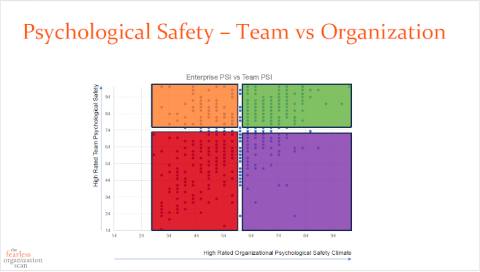
*used with permission from The Fearless Organization

In essence, psychological safety grows: from pockets in teams, to pools in departments, you can have influence and build a safer climate from the ground up.

Crucially, this also reflects how psychological safety attunes to a distributed or collective leadership model – what this means is that although top-down leadership visibly sets the tone, role-models constructive behaviours and charts the direction for the kind of culture that a team or indeed organisation wants to stand for, all members of the system have a role to play. 

And because psychological safety is co-constructed, this means that leaders at all levels of the organisation have agency. Whether you’re in a formal leadership role or not, you can learn skills and adopt practices that support the creation of psychologically safe spaces around you.

Leadership skills and practices that support psychological safety

So I thought I’d outline a few personal thoughts on some key leadership practices and competencies that support the development of psychological safety. It may be helpful to observe that, in all probability, much of this will not be in fact separate from what you are already doing, or what is already happening within your organisation. In this respect the intentional practice of psychological safety is wholly compatible with existing management approaches, leadership methodologies and inclusion practices. I hope that these will serve as some useful prompts for reflection, whether you’re thinking about this from your own individual perspective or have an organisational hat on.  

The leader as coach
There are a huge number of leadership styles that are talked about in the literature, and effective leadership is very much about being well-versed in multiple styles, as well as the ability to flex between them dependent on the needs of the situation. There is one particular leadership style, however, that I think is especially aligned with development of psychological safety in teams, and that’s a coaching style of leadership. This is all about building long-term capability in your team, through understanding their strengths and weaknesses and facilitating their development, and non-judgmentally supporting them to find the answers for themselves rather than dictating how things should be done. 

The effective leader-coach supports the development of psychological safety in their teams in several ways. Their focus on understanding and developing their team is not only a vital complement to the climate of empowerment and innovation that marks out high-performing teams, but also allows them to build the strong trust with their team members that is a vital foundational component of psychological safety.2

Your attitude to, and skill at dealing with, conflict
We all have different tolerances and attitudes towards conflict, starting with whether we see conflict as a healthy thing or not. Many of us equate conflict with confrontation, and instinctively avoid any prospect of it by not talking about things that should be talked about, preserving a false harmony that stores up problems for the longer term. Many of us don’t have effective tools for effectively resolving conflict when we find ourselves in it – instead we experience defensiveness, aggressiveness, blame and capitulation. 

Conflict can be productive, however – and you actually want productive conflict on your team, as part of an ability to enter into open, honest conversations. When team members can address problems directly and productively, explore different opinions with curiosity, and thoughtfully disagree with mutual respect, it’s an indicator of high psychological safety, and it boosts the team’s ability to problem-solve and innovate. 

At the heart of productive conflict is the understanding that we all experience reality in different ways – as Anaïs Nin said, “We do not see things as they are. We see things as we are.” The key to better working relationships is listening to understand so that we can expand our perspective and learn to hold the space for multiple realities. 

As a leader, understanding your attitude towards conflict and learning about different conflict management styles can be incredibly rewarding not just for your personal development but also in the interests of more effective communication with your team. Working not just on your conflict management skills, but also on how to facilitate genuine dialogue (as distinct from debate or discussion), and on building the insight required to ‘read the room’ – the system of structural dynamics – can help you to improve the way that your team talks, so that conversations which need to take place can happen constructively in the room, rather than being held back. 

Designing from the margins: are your practices inclusive and affirming?
In my last article on neuroinclusion, I wrote about how no two brains are identical, how neurodiversity therefore describes the human condition, and how inclusion is about embedding difference as standard. Authentic and holistic inclusion is the key to people feeling like they belong fully, and yet another vital component in psychological safety – and this safety and belonging are in turn fundamental for organisational performance. 

George Dei, one of Canada’s foremost scholars on race and anti-racism studies, states that “inclusion is not bringing people into what already exists; it is making a new space, a better space for everyone.” Moving towards truly inclusive systems requires us to think about how our current practices may inadvertently be exclusionary, particularly of those least likely to self-advocate and to speak up. So many of our standard practices are anxiety provoking, for anyone – recruitment and cultures of overwork are two areas that frequently come up in my leadership coaching – but the impact is especially brutal for the marginalised. 

As a leader, how do you reflect on your approach to inclusion? Are your practices designed to be affirming for those from the margins? For an in-depth foray into this I highly recommend a read of Ludmila Praslova’s groundbreaking inclusion framework as presented in The Canary Code – the analogy relates to the historic use of canaries in UK coal mines as living, breathing carbon monoxide detectors, now a modern metaphor of people who are particularly affected by dysfunctional organisational environments and injustices. The core principles of the Canary Code framework extend what works for neuroinclusion to supporting holistic belonging for all, creating the ideal conditions for psychological safety: workplace systems that are valid, flexible, transparent, trauma-informed, human-centric and talent-friendly.

I hope you’ve found this helpful – do share your thoughts if you have a moment. 

Natalie Snodgrass
Quiet Space Ltd

  1. PSI quartiles are 1st: 14-61 PSI, 2nd: 61-76 PSI, 3rd: 76-86 PSI, 4th: 86-100 PSI. Benchmarks for the dimensions have been baselined through a 4-month trial PSI from 2665 Fearless Organization Scan respondents. ↩︎
  2. Here’s a great article on the interplay between trust and psychological safety, if you want to read more: https://psychsafety.com/the-difference-between-trust-and-psychological-safety/#:~:text=Trust%20is%20necessary%20for%20psychological%20safety%2C%20but%20not%20sufficient.,in%20a%20team%20are%20set. ↩︎

Neurodiversity and neuroinclusion: embedding difference as standard

1. Introduction

This article was inspired by one of my neurodiversity and executive function coaching clients, whom I’ve been working with for several months now through the government’s Access to Work1 scheme. D was diagnosed with Attention Deficit Hyperactivity Disorder (ADHD) as an adult, with co-occurring Rejection Sensitive Dysphoria (RSD)2

At a recent session we celebrated a major milestone that shouldn’t have warranted being either a celebration or a milestone. D, after two long years, had finally received approval from her employer. For what, you ask? For the purchase of a non-standard work laptop with customised setup and specialist programmes, which would allow her to undertake her job duties much more efficiently and effectively. 

D struggles particularly with making presentations and fielding questions in the moment due to her RSD and the working memory challenges of ADHD, but when she’s made reasonable adjustment requests for questions to be submitted in advance for an important presentation that she’s also circulated a paper for in advance, this hasn’t been taken seriously because it isn’t a problem for anyone else and no one has made the time to read her paper before the meeting anyway. 

D is also having to secure her own funding in order to make sure that her manager and colleagues receive ADHD awareness training, and has to constantly self-advocate and push for change in the face of dismissive attitudes and workplace practices that are not effective for anyone, let alone neurodivergent people. We spent that session working to develop D’s disability passport3, and got into a discussion around neuroinclusion, the social model of disability, and what constitutes a ‘reasonable adjustment’ for disability vis-à-vis what is simply good workplace practice. 

2. Neurodiversity, neurodivergence, neuroinclusion: What does it all mean?

The language we use matters – it shapes how we see the world and one another, guides our behaviours, and reflects our values, beliefs and assumptions. So before I go any further, I think it’s worth briefly explaining what I mean when I talk about neurodiversity, neurodivergence and neuroinclusion, recognising that not everyone may have the same language preferences or make the same linguistic distinctions. 

Neurodiversity

When I speak about neurodiversity4, I’m referring to what are naturally occurring differences in human neurocognition. This is the idea that normal, natural human variation accounts for not just neurological differences such as autism or ADHD, but also simply the fact that no two brains function exactly alike. Neurodiversity, in other words, is standard: we are all part of a complex neurodiverse species. Each of our brains is unique, shaped by genetic factors as well as by each of our backgrounds, cultures and life experiences. The neurodiversity movement, a social justice movement that emerged during the 1990s, campaigns for the rights, equality, respect and full societal inclusion of all neurological differences, while increasing the acceptance and inclusion of all people.

Neurodivergence

Within that neurodiversity, most people have neurotypical brains. Others have less typical neurotypes – neurodivergent brains with pronounced strengths and weaknesses –  the ‘uneven cognitive profile’ or ‘spiky profile’ that I talked about in my last article on the autism spectrum, describing how autistic people (and neurodivergent people more broadly) may have significant strengths in one area, but be severely lacking in another. Collectively we might also refer to neurominorities.

At an individual level, people may relate to different terms and have preferences for how they want to refer to their diagnosis conditions. They may, for example, identify as neurodistinct or neurodifferent rather than neurodivergent, given that ‘divergence’ from the standard isn’t necessarily neutral and can still feel loaded with judgment. Or sometimes ‘neurospicy’, which still makes me smile whenever I come across it. Or they may avoid the overarching terms altogether and prefer to identify with their specific condition, e.g. “I’m autistic/dyslexic/I have ADHD”. 

Neuroinclusion

What, then, about neuroinclusion, and where it sits under the broader umbrella of equality, diversity, inclusion and belonging? When I talk about neuroinclusionI’m referring to recognising, respecting and creating a level playing field for neurocognitive differences in exactly the same way as we strive to do with differences in race, religion, sex and gender and all other human variations. Neuroinclusion is about embedding difference as standard.

3. Challenging our biases: neurodivergent strengths, the social model of disability, and the neurodivergent lived experience 

I think that the first thing we need to do is stand back and challenge our perceptions, filters and biases. The 2020 Institute of Leadership research report “Workplace Neurodiversity: The Power of Difference” revealed that 50% out of 1,156 UK employers admitted that they would not employ a neurodivergent person (with the highest level of bias existing towards Tourette’s and ADHD). Survey outcomes also showed a significant lack of understanding and awareness about neurodiversity, despite an estimated 1 in 7 of the population being neurodivergent.

A couple of quotes from the report that stuck with me: 


“It is a common misconception that people having one of these conditions (…) are less intelligent and less able, whereas in fact there is no association between intelligence and neurodiversity.”

“Most employers are scared to hire neurodiverse people as they only calculate the risks based on the deficits of the condition.” – Claire Smith, CEO, Autistic Nottingham


So far, so disheartening.

Neurodivergent strengths

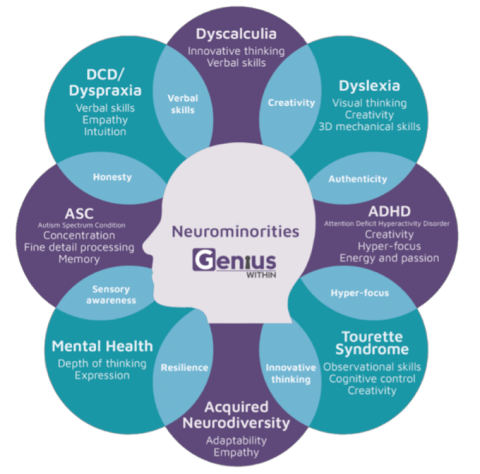
So let’s swap over that negative filter and instead look at the diagram below from Dr Nancy Doyle, which gives a great, simplified overview of the overlapping strengths of different neurodivergent conditions. The diagram includes diagnoses that tend to be more commonly encountered (if not necessarily commonly understood) such as autism and ADHD, but also, for example, the recognition that anyone who may have been neurotypical by birth can become part of the neurodivergent community later in life, through acquired brain injury.

Dr Nancy Doyle, drawing from the work of Mary Colley

One of the neurodiversity movement’s main goals is to shine a light on the benefits of this diversity. For example, my autistic or ADHD coaching clients may have sought support to deal with executive functioning challenges, but we aim to work together in a way that seeks to productively channel and build on their vibrant creativity; passion; ability to hyper-focus; complex problem-solving abilities; or novel, unusual insights and perspectives.

Society disables people, they’re not necessarily disabled: the social model of disability

Neurodistinct people are differently abled because of underlying differences in neurocognitive function that can lead to various impairments. The main issue is not in the impairments themselves, but what arises when we don’t account for those impairments. This is the perspective of the social model of disability, which frames disability as predominantly a social construct in which attitudes, practices and structures create limits on individuals’ functioning, and put barriers in the way of them reaching their valued goals.

What often happens, even in organisations that on paper have the right policies and procedures in place, is that neurodivergent people have to fight for access to the adjustments or considerations that would make it easier for them to engage and manage at work. Apart from D, some other real-life examples I’ve seen have included the “If I make this allowance for you I’ll have to make it for everyone” argument around headphones in the office to help with focus; insisting that someone stay at their desk to work rather than having autonomy to go for a walk to think through a data problem; refusing a request for a desk located in a quieter and more enclosed corner of an open-plan office to manage sensory overstimulation; and a three-line whip for compulsory team bonding activities. 

In other words, even if we recognise and hire for strengths, we don’t consistently and proactively support to level the playing field for impairments. Instead, we refuse to trust our talented people, and place the burden right back on the individual to have to self-advocate and negotiate daily hurdles just to be able to do their jobs. 

Daily living for many neurodivergent people is often invisibly tough. Neurodivergent populations are significantly more likely to be exposed to trauma and adversity across the lifespan. Many struggle with mental and even physical ill health from the imprint of childhood traumas, as well as an increased likelihood of experiencing further trauma as an adult through the impact of workplace bullying, discrimination, and feeling misunderstood, unheard, and unseen. It’s unsurprising that, for those whose neurodivergence can be concealed, it often is: in order to fit in, rather than cope with the cost of being different. And so not only is support not requested, but disclosure not made due to self-protection – at great private and personal cost.

If we were really committed to truly neuroinclusive ways of working, disability would not have to be the inevitable outcome for many neurodivergent individuals.


“Impairment is a fact of life, but disability is a social and cultural artifact” – Professor Tom Shakespeare, Royal Institution of Great Britain talk (YouTube link)


The social model of disability stands in stark difference to what is still the norm – the medical model, which says that people are disabled because of their impairments or differences.

The difference is important. The medical model drives us towards an impairment-focused conversation in which neurodivergent people need to be modified or accommodated so that they can fit within neurotypical designs and standards. It also drives the focus towards legislative and policy frameworks, checklists for what workplaces need to do to meet their obligations, and concerns over what managers ‘can and can’t say’ in order to be compliant. ‘Disability’ in this context can become a dirty word.

Understanding the neurodivergent lived experience: examining our assumptions and revising our models

The experience of D, whom I mentioned at the start of this article, is not unusual. The sad thing is that her workplace is, actually, relatively progressive in its attitude towards neurodivergence.

As we’ve seen, a lot of that attitude is bound up in lack of knowledge, partial information and misunderstanding. It’s also rooted in a lack of motivation to step back and rethink the things that ‘we’ve always done this way’, because ‘we’ aren’t the ones on the burning platform and don’t personally experience the need for change. Part of the difficulty here stems from the fact that neurodivergent traits may look eccentric and can even seem to conflict with what workplaces usually associate with professional competence, such as social and political awareness, tact and diplomacy, productivity and good timekeeping, and being a ‘team player’ who doesn’t require any particular managerial attention.

This, however, doesn’t mean that neurodivergent people aren’t good employees. It means that our notions and standards for what constitutes a good employee need to shift, adapt and expand; that we need to examine our damaging assumptions and stereotypes; and that we need to create supportive conditions not just for neurotypical performance but also neurodivergent excellence. 

For example, many autistic people’s communication can come across as very direct, often blunt, which can jar with a mode of communication that is used to greater subtlety. One potential downside of greater subtlety, however, is that one of its common bedfellows is not actually saying what you mean. Thus the neurotypical ear is trained not to take what it sees on face value, and tends to search between the lines for what may have been implied, omitted or disguised. In unhealthy workplace cultures, this creates a constant wariness in employees who are concerned or suspicious about what their colleagues aren’t telling them. This is the beauty of direct and honest communication, and many autistic people have it in spades. It is straightforward and unambiguous, there is no game-playing, and everyone knows where they stand. This is not to say, of course, that better communication skills don’t need to be cultivated. But the learnings are for both neurotypical and neurodivergent people alike.

Another example that comes up frequently in my coaching work is the strong sense of justice that many neurodivergent people experience. This can emerge as an intense need to speak up and persist when others remain silent in the face of unfairness or a violation of rights and principles, which can often lead to being labelled as a ‘troublemaker’. When we take a step back to look at what’s really going on here, we may realise that the real challenge might be a workplace without a healthy level of psychological safety (more on this below) in which honest opinions and feedback can be discussed without threat of recrimination, blame or punishment.

There is a valuable opportunity here for a curious, empathic dialogue that has compassionate humanity at its core, seeks first to understand, and is committed to finding ways to genuinely live out what it means to be inclusive.

4. A vision for neuroinclusion

Neuroinclusion benefits everyone: think of inclusion by design

I want to start with the core premise that, just as difference is standard, neuroinclusion benefits everyone.When we remove barriers for a few, we can increase accessibility for all. Through this we can begin to do some important reframing: from adjustments and accommodations being ‘special treatment’ or even an inconvenience, into an opportunity for us to create the conditions for high performance for all our people.

The principles of neuroinclusion by design – thinking about the needs and abilities of your neurodivergent employees when creating spaces, systems, processes and practices – are pretty aligned with Universal Design, which is the design of buildings, systems, environments etc. so that they can be accessed, understood and used to the greatest extent possible by people regardless of age, disability or other factors. This is not a special requirement, for minority benefit, but is in fact a fundamental condition of good design.

This can happen at the most basic of levels, like with D. One of the requests on her disability passport was for the introduction of written agendas, to be circulated in advance of scheduled meetings to support preparation and a clear, predictable flow of discussion. What in some organisations is already standard administrative practice is still a ‘reasonable adjustment’ request elsewere, but this also gives us the precedent and model for changing our thinking.

Recruitment is a great area of focus for organisations looking to embed inclusive design in their processes. Many tweaks can benefit all candidates, not just neurodivergent ones, and allow them to show up at their best. Some quick and no-cost options include thinking about the detail and structure of the information that’s issued to candidates pre-interview – clear timings and venue information, details of who will meet candidates on arrival and who will be on the panel, and clarity on how the interview will be structured. Providing a hard copy of questions at or just in advance of the interview can serve as an important aide memoire not just for candidates with working memory challenges, but also all candidates who can get anxious and overwhelmed under the interview spotlight.

Psychological safety: create a high-performance environment where all people feel safe to show up fully and authentically

Psychological safety is present when colleagues trust and respect each other and can speak up with candour, airing their ideas, questions and concerns and making mistakes, without fear of humiliation or retribution. It’s a shared belief, held by members of a team, that the team is safe for interpersonal risk-taking. First conceptualised in the 1990s by Professor Amy Edmondson from Harvard5, over 20 years of research have since identified psychological safety as the #1 top differentiating factor in what makes a high-performance team, and a pivotal factor in increasing collaboration and innovation. 

When I think about inclusion, I have often concluded that we limit ourselves because we spend lots of time focusing on our frameworks, charters, policies, processes, etc., but then stop short of what happens in the small spaces: the quality of our human interactions.

How do we create thoughtful spaces for conversation where all of us feel safe not only to show up as we are, but also to take up our rightful space and use our voice? This is the practice of creating psychological safety. Showing up in this way takes vulnerability, and all the more so if you’re neurodivergent. We don’t see the additional cognitive load it’s taking an autistic colleague to work out unspoken social group norms, or how someone with auditory processing disorder may need additional time to process what’s been said before they can think about a response, or when we lose valuable contributions from neurodivergent or socially anxious colleagues who have difficulties in navigating group discussions and so, feeling unsafe, choose to stay silent. When we create spaces in which people feel safe to be vulnerable, we create spaces in which people can be at their best.

Give your managers licence to operate, with clear guidance around adjustments to individual work contexts

In several unrelated conversations last year with various senior university leaders I was interested to hear the same question popping up: how do we get people to move away from a culture of permission seeking? We keep telling them to take risks and they don’t! 

There is a clear link here to psychological safety – and what happens when you don’t have it. In an organisational culture where there is fear around the consequences of taking risks, you can’t simply tell people to take risks. Rather, you have to not only actively model risk-taking, but also systematically reframe and destigmatise failure; invite participation; set up structures and processes to build people’s confidence that voice is welcome; express appreciation; and regularly refresh your orientation towards continuous learning. This is the same kind of environment that invites and nurtures inclusion. 

Within permission-seeking and risk-averse cultures, requests for reasonable adjustments often get framed as issues that need solving. They also tend to create bureaucratic delays through unnecessary layers of approval. Giving managers greater licence to operate, with greater autonomy over their staff budgets, can make the process of making reasonable adjustments an integral and value-added part of boosting staff performance. It’s worth making the observation that many adjustments can be undertaken at negligible to relatively low cost, and that ‘fair’ doesn’t mean treating everyone in the same way.

An important observation worth reflecting on, if you’re a manager yourself, is how you can be proactive about supporting your neurodivergent team members. Asking for adjustments can be difficult not necessarily because of the request itself, but because it’s not always clear what to ask for or what would help. Organisations can support this through developing resources noting the different adjustments that may have been made in the past and what options there might be, which can be a helpful springboard for discussion. 

Educate staff and encourage allyship within your organisation

We all have biases, blind spots and imperfect knowledge, and we have a natural tendency to gravitate towards and favour people who are similar to us. In a neurotypical world, our neurodivergent colleagues can, through no fault of their own, be subconsciously judged and left on the outside. 

Changing this requires awareness-raising and education – we cannot challenge our own biases until we are aware of them and have the language to talk about them. Neurodiversity awareness training and education through e-learning, webinars and toolkits, provided by specialist psychological consultancies like Lexxic, are great ways to reach large numbers of staff and start conversations about neurodiversity in your organisation. 

You can also make an impact as an individual through becoming an ally. As an ally, you might not be neurodivergent yourself, but you can support and take action to help your neurodivergent peers. There are a number of ways in which you can do this:

  • Listen to your neurodivergent colleagues, learn from their lived experiences, and actively educate others.
  • Speak out if you see discrimination happening.
  • Volunteer to act as an inclusion ambassador, dignity at work contact, or other similar roles within your organisation, or get involved with any relevant employee resource groups (ERGs).

5. Neuroinclusion is a shared responsibility

Neuroinclusion isn’t someone else’s responsibility. We all need to play a part, and we can make a big impact even in the everyday gestures. It does mean that we have to look at and do things differently from how we may have been used to in the past, but this is the essence of inclusion – that we all take our share of the heavy lifting in making this world a fairer place. 

Natalie Snodgrass
– Quiet Space Ltd


  1. Access to Work (AtW) is a government grant that funds practical support if you have a disability, health or mental health condition. Your disability or health condition must affect your ability to do a job on a day-to-day basis or mean you have to pay work-related costs, and the funding can support a wide range of support such as a support worker or coach, specialised equipment, travel fares to work if you can’t use public transport, and disability awareness training for your colleagues. The grant does not have to be repaid.
    The aim of the scheme is to help you start work, stay in work, be able to move into self-employment or start a business. To be eligible you have to be over 16, self-employed or either in a paid job or about to start a job or work trial with an employer based in England, Scotland and Wales (there’s a different system in Northern Ireland). Full details are available on the AtW website. ↩︎
  2. See this Additude Mag link for some info about RSD. ↩︎
  3. Disability or reasonable adjustment passports (also known as workplace adjustment passports) were introduced following a GMB motion at the TUC’s Disabled Workers Conference in 2018. They provide a continuous, portable record of an individual’s agreed workplace adjustments that can be transferred when the individual changes roles or managers, avoiding the need for the adjustments to be re-explained and re-negotiated. Further information is available here from the TUC. ↩︎
  4. Judy Singer (Amazon link to updated reprint of Singer’s original 1998 thesis “Neurodiversity: The Birth of an Idea”), an Australian sociologist, coined the term ‘neurodiversity’ as one of the seminal ideas in her pioneering work that mapped out the emergence of what was, at the time, a new category of disability with no name. ↩︎
  5. Professor Edmondson’s profile at Harvard Business School. ↩︎
Autism spectrum wheel showing an example autistic individual profile

We’re all a little autistic…and other mistruths

Some three years ago, I responded to a recruitment call from an organisation called Connections in Mind (CiM), who were looking for executive function1 coaches. CiM specialises in raising awareness and understanding of neurodiversity and the impact of living with neurodivergent conditions, as well as coaching neurodivergent children and adults to develop their executive function skills – and, more broadly, perform to their full potential. 

Since taking on that executive function coaching work with CiM, I’ve had the opportunity to work closely with numerous neurodivergent clients, supporting them in dealing with the daily challenges brought about by living in a world that is, more often than not, stacked against them. As a mother to an incredible son with ADHD, and as a partner to a brilliant autistic man who also has ADHD, I’ve also seen those challenges through a very personal lens. 

It occurred to me that although this work is hugely important to me I haven’t written anything about any of it. So I thought I would start with something that often comes up when I have conversations about this – the idea that ‘we’re all a little autistic’ or that ‘everyone is on the spectrum somewhere’. 


What actually is the autistic spectrum?

I think that this perspective has its roots in a misunderstanding of what the autistic spectrum actually is.

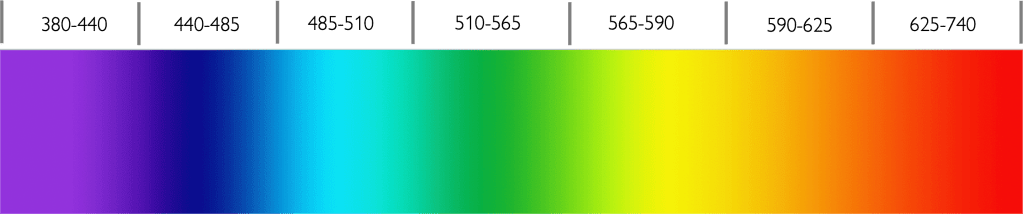
I’ve seen comparisons made to the visible light spectrum and I think it’s a useful analogy that I’m going to reproduce here. So this is a representation of the visible light spectrum – the portion of the electromagnetic spectrum that’s visible to the human eye. As wavelength gradually increases, we move from violet to red:

We can describe each colour on the spectrum in terms of gradients or intensities. Red, for example, can range from pale to quite intense. We don’t, however, compare colours in terms of how far along the spectrum they are, or how they are positioned relative to either end of the spectrum. Violet isn’t ‘not very red’, and green isn’t ‘middle-of-the-road red’, and red isn’t ‘acutely red’, or somehow ‘more on the spectrum’ than violet is:

What I often encounter is a perspective of the autistic spectrum that looks like this:

I’ll put aside the problematic nature of functioning labels2 for now (if you’re interested in this, have a look at the footnote) to make the point that we tend to think of spectrums in terms of linear progressions, and so the conversation around autism is often how someone is autistic to a less problematic (to other people) or somehow more drastic/severe/tragic extent. 

What does this tell us? When people talk about someone being ‘more’ or ‘less’ autistic and ‘everyone being on the spectrum somewhere’, it seems to me that they’re thinking about a question of gradient, like we were all varying intensities of red. Like any two neurotypical people, no two autistic individuals are identical, and the idea that you can position them all along a scale of increasing degrees of autism is damaging, because it diminishes people to reductionist stereotypes. 

In fact, it’s also fundamentally incorrect, because you can’t be ‘a little bit autistic’ or ‘very autistic’ in the same way that a colour can be intensely red or pale red. It would be like saying someone was ‘a little rainbowy’ when they were only wearing blue and red. 

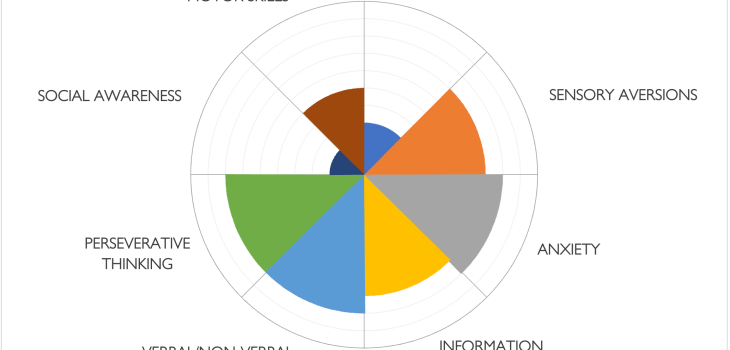
This is because the autistic spectrum is not a linear spectrum. I’m going to illustrate this point with the autism wheel or pie chart, which I think presents a much more accurate portrayal of the diversity of experience within autism and gives us a helpful visual representation of what the autistic spectrum really looks like. 

The autism wheel, or autism pie chart

The illustrative examples above show us how autism might manifest very differently in two autistic individuals. In the two contrasting charts, you’ll see how individual autism traits are represented by separate wedges of the pie. (In these examples it’s important to note that the pie chart represents a simplified picture of autism and does not include every relevant trait.) 

Challenges in multiple areas across the autistic spectrum

The first crucial observation to make is that all autistic people are affected in one way or another in most or all of the individual traits represented in each chart above. Neurotypical people may well have challenges in one or two of these areas, but in order for someone to be considered autistic, they must have difficulties in multiple categories across the autistic spectrum. If you only have a slice of the pie – if you only have difficulties in a couple of these areas – then you aren’t ‘a bit autistic’, although you may well be neurodivergent in another way. For example, if you have significant issues with only sensory processing, you might have sensory processing disorder. Or if you struggle with certain executive functions such as self-control and the ability to focus attention and task-switch, allied with social awareness challenges, you might have ADHD.

The uneven cognitive profile and the problem with making assumptions

The autism wheel/pie chart also provides a clear visual representation of one of the distinguishing features of autism that is described in the DSM as an ‘uneven profile of abilities’, or an ‘uneven cognitive profile’. This basically describes how someone on the spectrum may have significant strengths in one area, but be severely lacking in another. Taking the left profile above, one example might be someone with very high verbal and academic ability, who also struggles with social awareness, high anxiety and perseverative thinking – becoming very fixated on particular thoughts or tasks and being unable to redirect their attention to other things. To much of the external world they may be mildly affected by their autism. In reality, however, they may have hugely disabling executive dysfunction that has a significant impact on their employment prospects and relationships.

In contrast, the right profile might represent someone who more closely fits the stereotypical ‘severely autistic’ profile – mostly non-verbal, with neuro-motor differences and high repetitive behaviours. Yet that individual may have much higher social awareness and information processing capacity than might be perceived.

Being aware of this uneven profile is important because we often make assumptions about a person’s overall ability and capacity when looking at a slice of their strengths or challenges. As Bradshaw, et al. (2021), for example, note: “Using functioning labels and autism levels overlooks the real challenges and barriers of autistic people who may not outwardly appear different, and minimises the strengths, abilities, and capacities of those who do.” 

Neither of the individuals above is ‘more’ autistic than the other. Autism comes in all shapes and sizes, and each individual’s experience of autism is uniquely their own. That experience can also change and develop over time, and the autism wheel or pie chart also acknowledges and accommodates the possibility of that fluid development.


In writing about this I’ve been reminded that there is so much that I have learnt over the past few years not only about neurodivergence itself, but also about my own attitudes and biases with regard to performance, resilience and patience. However, I’ve also learnt about how much I still don’t know, and that although general awareness and understanding of neurodivergence has come so far in recent years, we still have a long way to go to shape a world that is genuinely neuroinclusive. 

I hope that you will take two things away from this brief article. The first thing is that, in future conversations, you too will have the ability to correct the misapprehension that ‘we’re all on the spectrum somewhere’. Although I think it’s important to recognise that people may have good intent when they say this, the real impact of loose identification like this is that it can be very hurtful and disheartening for autistic people as it diminishes their lived experience. 

I also hope that I, as much as you, remember to continually question the assumptions that we may be making about our autistic family members, friends and colleagues. Dr Stephen Shore, an autistic professor of special education at Adelphi University and an advocate for autism awareness, says that “If you’ve met one person with autism, you’ve met one person with autism.” Like any other person, autistic people are individuals with unlimited potential, and we need not to measure people on the basis of what may be visible. 

As always, I’d love to hear your thoughts – drop me a comment or message and let’s start a conversation.

Natalie Snodgrass
– Quiet Space Ltd


Footnotes

  1. Executive functions (EFs) are the high-level cognitive functions that enable us to successfully undertake tasks such as planning and scheduling our time, focusing our attention, remembering instructions, regulating our emotions, and keeping going in the face of challenge. Moderated primarily by the frontal lobe in our brains (specifically the prefrontal cortex), the core EFs relate to three types of brain function: working memory, self-control, and mental flexibility. Whilst we all have difficulties with executive functioning from time to time, neurodivergent brains can often experience particular EF challenges. In EF-focused coaching, we help people to build skills and strategies to improve their executive functioning, which strengthens the foundations upon which they are then able to build the lives they want to lead. 
  2. ‘High-functioning autism’ is an unofficial term often used for individuals with autism spectrum disorder without an intellectual disability (Alvares et al, 2020) – in other words, whose autism symptoms may appear mild to the outside world. This term is not used in official diagnostic criteria, set out in diagnostic manuals such as the ICD-11 and DSM-5 (the International Classification of Diseases and the Diagnostic and Statistical Manual of Mental Disorders). The DSM-5, for example, categorises autism in terms of the severity of the condition and how much support a person requires in daily life. Level 3 (requiring very substantial support) includes those who may have significant learning difficulties, Level 2 (requiring substantial support) includes people who would struggle to live independently, and Level 1 (requiring support) includes people without intellectual disabilities who have the capacity to live independent lives. ‘High-functioning autism’ often gets used interchangeably with Level 1 in this respect. 

    Functioning labels are problematic because how well someone functions can actually fluctuate significantly on a day-to-day basis. And even though the diagnostic categorisation has moved away from functioning labels, I have to confess that I still find autism categories problematic, because it is small comfort to know that you are either ‘high-functioning’ or require little support on a day when your anxiety and sensory over-stimulation is so intense that the only way you can cope is by hiding from everything. People can also be high-functioning in some areas while having significant difficulties in other areas (a distinguishing feature of autism – what’s described as an ‘uneven cognitive profile’). And despite other common misconceptions, ‘high’ function doesn’t necessarily equate with an absence of learning difficulty, nor ‘low’ function with being non-verbal. 

References

Alvares, G. A., Bebbington, K., Cleary, D., Evans, K., Glasson, E. J., Maybery, M. T., Pillar, S., Uljarević, M., Varcin, K., Wray, J., & Whitehouse, A. J. (2020). The misnomer of ‘high functioning autism’: Intelligence is an imprecise predictor of functional abilities at diagnosis. Autism, 24(1), 221–232.

Bradshaw, P., Pickett, C., Brooker, K., Urbanowicz, A. & van Driel, M. (2021). ‘Autistic’ or ‘with autism’? Why the way general practitioners view and talk about autism matters. Australian Journal of General Practice, 50, 104-108.