Blog

Blog

Coaching

The pilgrim’s journey

Camino recto camino erguido

Carved on all four sides of this sculpture outside the pilgrims’ museum in Santiago de Compostela is this quote:

Camino recto, camino erguido, camino buscando un sentido. Camino porque tengo un objetivo, y no pararé hasta alcanzar mi destino.

(I walk straight, I walk upright, I walk looking for meaning. I walk with a purpose and I won’t stop until I meet my destiny.)

The pilgrim’s journey is the same one you and I are on. Know your goals and understand your challenges. Face them head-on, tackle them with intention, and never give up.

Do you know what your purpose in life is? What would you say if someone asked you what your destiny was?

– Written by Natalie Snodgrass Tan, Quiet Space Ltd

Coaching

De Bono’s Six Thinking Hats

Camino de Santiago wall of hats
Here’s a wall of hats in a café somewhere along the Camino de Santiago. My less-than-stellar note-taking means I’ve entirely forgotten where it was and I haven’t consulted my peregrino passport so you’ll just have to content yourself with ‘wall of hats’.

Today, however, it’s a visual prop for de Bono’s ‘Six Thinking Hats’. We all have particular thinking frameworks and habits that we tend to utilise, but we can often benefit from looking at things in different ways. Try this exercise with your coach or a friend the next time you’re problem-solving or trying to make a decision.

1) The White Hat calls for information gathering. Ask yourself: What factual information do you have about the issue? What does it tell you? What other information do you need or want?

2) The Yellow Hat is optimistic yet logical. You put on this hat to explore the positives of a course of action and to understand what value and benefit it would bring.

3) The Black Hat is critical evaluation. Can be overused to the detriment of the other hats. Black spots the risks and difficulties so you can work out a plan to manage them.

4) The Red Hat signifies feelings, hunches and intuition. The heart and gut hat.

5) The Green Hat focuses on creativity – possibilities, alternatives, and new ideas. What haven’t you thought of? What would happen if you approached this problem from a completely different viewpoint?

6) The Blue Hat is a bit like internal audit! This is the hat to be worn by your coach or facilitator and is used as a control mechanism in the thinking process. Blue Hat helps you to manage your other hats and guide and stimulate the process.

There you have it. Hats.

– Written by Natalie Snodgrass Tan, Quiet Space Ltd

Articles

No, you’re not a fraud: Tips for overcoming impostor…

[I resolved to write about this a few weeks ago, and since then, three articles have popped up in my LinkedIn and Facebook feeds on precisely the same thing. Clearly it’s an issue that is occupying the thoughts of other people too. I did wonder whether I should still write this given that there already seemed to be so much out there on the topic. But then I decided I had something of my own to contribute, so here goes!]

It’s about impostor syndrome. You know, when you don’t think you’re good enough to be where you are, like your success is entirely attributable to external factors and people are just being nice when they say positive things about you and your work. When you think you’re a fraud and you’re just about to be found out. You’re particularly vulnerable to it when you start a new job or take on new work responsibilities.

impostor-syndrome-cartoonImage © Bradford Veley

The first observation I’ll make is that you’re in good company. Apparently some 70% of the population suffer from impostor syndrome at some point. Better than that, you’re in the company of lots of very talented high achievers who are all frauds in their own heads (a quick Google tells me that Sheryl Sandberg, Leonard Cohen, Maya Angelou and Neil Gaiman were – or indeed are – no strangers to this). So it’s not just you. It’s me, and them, and more likely than not the role models you look up to.

Knowing other people feel the same way too can help with perspective, but of course you’ve still got the problem. So here are a few tips, thoughts and questions to ask yourself to help you overcome impostor syndrome.

  1. Awareness and acceptance is the first step. Accept that you’re feeling like a fraud, rather than run from it or be frustrated by it. Where’s the feeling coming from?Very often the roots of impostor syndrome lie in patterns we’ve learnt while growing up. Maybe some of these will find resonance with you: Vesting too much of your self-confidence in achievement; needing to get external proof of success because you lack internal validation; having expectations of yourself that you would tell anyone else were unreasonable.You set high standards for yourself. You want to be able to make sure that you know what you’re doing and that you’re going to do it well. That is laudable. It’s ok to feel like a fraud. But your feelings are not you. And I can guarantee that if you’re worrying about feeling like a fraud, you are almost certainly not. So stick a finger up to the feeling, so to speak, and remember you are doing a far better job than you think you are.
  2. Give yourself permission not to know. You’ve not been appointed to your post because you are an expert in everything. More likely than not, you’ve been appointed because people who know what they’re doing trust your track record and have experience in spotting talent.If you’re in a new post, don’t be afraid to start by asking questions. There’s power in the unknown. Knowledge can be a barrier to progress sometimes – people get mired in ways of doing things because “that’s what we’ve always done”. There is baggage in the past: “We can’t do that because we’ve tried and failed before”. Not knowing is freedom to think differently, and it also allows you to fully capitalise on all the strengths of your team. A great leader is not someone who knows everything; instead, they know who to ask, and how to delegate. They know how to recruit and nurture great people and how to give them authority and autonomy to do what they do best.The truth is, no one has all the answers. Even experts don’t know everything about anything. And people respect you much more when you admit that you don’t know, rather than try and bluff your way through (i.e. actually be a fraud!).
  3. Learn to treat things as experiments. Being ok with ‘failure’ can be a difficult thing to learn. The thing is, no experience is a failure if you learn from it. Experimenting is how great things in this world were created. It’s not about success or failure; it’s about a continued capacity to learn and grow.
  4. Step back and take an objective look at your previous achievements. Perfectionism is closely associated with impostor syndrome, which means that you probably put in long hours making sure you excel. What would a trusted mentor say about your competence? And your confidence? Chances are, you’re probably doing a pretty good job, even if you don’t think so right now. If you’re new to your role, it’s also likely that, because you have perfectionist tendencies, you’re assessing yourself on the basis of your peak – what you think you should be achieving and how you should be feeling as a seasoned performer – and forgetting that every expert in their field started as a beginner. Think in terms of familiarity, rather than competence. You are perfectly competent, but it will take time for you to become fully familiar with the role. On this note, it helps to keep all the positive feedback you receive! I have a little keepsake folder in which I put all the nice comments people have sent me and my own record of the achievements I’ve been proud of. When you’re feeling like a fraud, revisit these and bring that pride into your present moment.
  5. Don’t compare yourself with others. Comparison is the fuel for crippling doubt. You’re almost always your worst critic, and if you’re new to something, you’re probably comparing yourself with others who are at a very different stage of their journey. They were where you are. They’re in their time zone, and you’re in yours – and you’re very much on time, all present and correct.
  6. Focus on and celebrate your strengths. One of the fastest ways to overcome impostor syndrome is to stop focusing on all the things you don’t think you’re any good at, and start focusing on your strengths. Try one of these (free) online strengths profilers: https://www.viacharacter.org/survey/account/register and https://tools.atmybest.com/#/home?linkType=SoloTrial.
  7. Boost your confidence simply by paying attention to people. Regardless of what your strengths are, you can make an immediate positive impact simply by making people feel heard and appreciated. Lots of people don’t genuinely listen; they’re just waiting for a gap in the conversation to make their own point or to make their mark. Listen to your team and the people you work with, make them feel heard, and then make a positive difference for them.
  8. It’s not fake to “fake it till you make it”. Last month, I wrote about identity (https://quietspacecoaching.co.uk/2017/12/06/identity-and-the-community-of-selves/) and how it can be helpful to think about this not as a single entity, but rather as a ‘community of selves’ that come to the fore in different arenas of your life. When you’re dealing with impostor syndrome, the problem is that there’s a bit of an identity gap between (a) the person you believe you are, and (b) the person other people see you to be. Closing the gap requires you to start internalising your achievements so you start to validate yourself, rather than doubting and second-guessing the external evidence of your success. Someone once told me, when I was battling a major case of self-doubt, to pretend until I found I didn’t have to. All I could think of at the time was that I couldn’t be inauthentic. What I’ve since realised, however, is that there was nothing inauthentic about it. I was already person (b), but my confidence was still playing catch-up. Assuming the mantle before I could identify with it wasn’t me being false; it was me learning to become familiar with a space that would let my mind step into the person I already was.

So there you have it; my tips for overcoming impostor syndrome. I’d love to hear your thoughts! Do get in touch if this has resonated with you, or if I can help in any other way.

– Written by Natalie Snodgrass, Quiet Space Ltd

Coaching

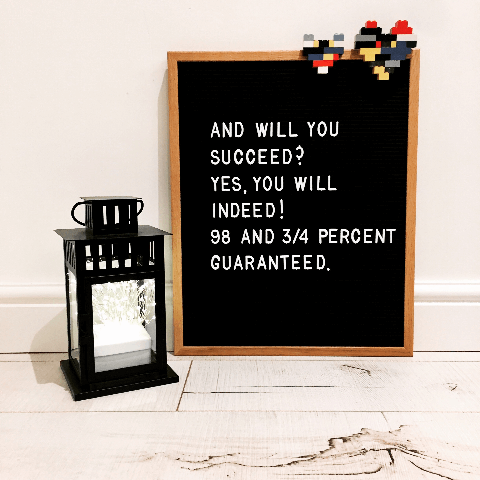
98 and 3/4 percent guaranteed

Dr Seuss 98 and 3/4 percent guaranteed

I had a bit of a confidence wobble today. Maybe some of you did too. Here’s a message for all of us. Remember: one step at a time. Set yourself achievable goals, and don’t worry about the final picture – just focus on achieving each goal as you go, stepping back now and again to reevaluate where you’re going. Talk to people; don’t try to do it all alone. They will be an integral part of your success story. And YES, you will get there. 98.75% guaranteed! (Dr Seuss says so, so it must be right.)

– Written by Natalie Snodgrass Tan, Quiet Space Ltd

Personal development

Goodbye 2017, hello 2018

A year ago today, I bid goodbye to my year of crisis. In 2016 depression got the better of me and I spent the rest of the year hauling myself back to a better place. I learnt lots of things, including how to take much better care of myself. Like how not to take things personally, leaving work in the office, knowing when to say no, making micro-resolutions, not sweating the small stuff, and embracing lots of new experiences. I started playing rugby and running regularly, joined a choir and dabbled in acro yoga, and attended my first music festivals and live gigs.

2017 has been kind to me, and I’ve been kind to myself. I’ve been altogether more sanguine about life. I completed my postgraduate qualification in career development and coaching, then took the plunge with a year-long work sabbatical. In just two months since leaving the 9-5 in October, I’ve launched Quiet Space, established a website and social media presence, networked, designed and developed programmes, and learnt so much about business development, branding, sales and marketing. None of this has actually felt like work, because I finally feel like I’m doing what I should be. And above all – I’ve been proud to be part of the transformational journey of my amazing clients.

I have lots of plans for 2018, but for now I’m looking back to appreciate all the things I’ve achieved. I’m proud of myself, and enormously thankful for all the love of my family and friends, who’ve gotten me through it all.

Look back on 2017 and see just how far you’ve come. Notice what skills you’ve learnt. The insights you’ve had. The people you’ve helped. The new experiences you’ve embraced. The challenges you’ve faced head-on. The friendships you’ve made. You are amazing. I guarantee it.I wish you all an amazing 2018. Love is louder than all of it.

– Written by Natalie Snodgrass Tan, Quiet Space Ltd

Coaching

Show them you’re worth it

IMG_6164

Just a few days left of 2017; time to do a final bit of soul-searching!

What were your adult relationships like this year? Were they a healthy meeting of minds; a set of equal partnerships? Or did you fear what others were saying about you? Did you feel judged? Were you a doormat?

If you want people to treat you differently, first you have to show them how you should be treated. Start by looking inward. Healthy relationships start with you being whole and valuing your worth. You need to realise your value and start to treat yourself differently before you can show the world you’re worth it.

I’ve been there. It’s hard. But I’m here to show you that it is absolutely possible. Come follow me and let’s be awesome together in 2018!

With love, Natalie x

– Written by Natalie Snodgrass Tan, Quiet Space Ltd

Coaching

Coaching miniseries: the video

Some highlights of the recent coaching miniseries, brought to you in video form!

– Written by Natalie Snodgrass Tan, Quiet Space Ltd

Career development

New year, new career resolutions

New year, new career resolution

What was 2017 like for your career?

“I’m unhappy but I don’t know how to change things.”
“I feel like I’m in a career rut.”
“I want to look for a new job but I don’t know where to start.”
“I’m applying for jobs but I’m not getting any interviews!”
“How do I get a job like the one she has?”

Does any of that resonate with you? Do you want some answers? I can help. Get in touch if you want to:

1) Find out what your career identity is and what your career options are.

2) Discover what you value in a career and what motivates and drives you.

3) Build confidence through gaining greater awareness of your key strengths and skills as well as your self-limiting beliefs and assumptions.

4) Work out your career goals in the short, medium and longer term and whip up an action plan.

5) Get networking tips, polish your CV, learn about the hidden job market and land your dream job in 2018!

Even better, get 20% off till the end of December! http://www.quietspacecoaching/services/career-health-check. Email me for a no-obligation chat.

– Written by Natalie Snodgrass Tan, Quiet Space Ltd

Coaching

What choices are you making?

You always have a choice how to respond

Every waking moment is one in which we are making a choice to do one thing and not another. Take control and make active choices about how you’re going to construct your life.

– Written by Natalie Snodgrass Tan, Quiet Space Ltd

Coaching

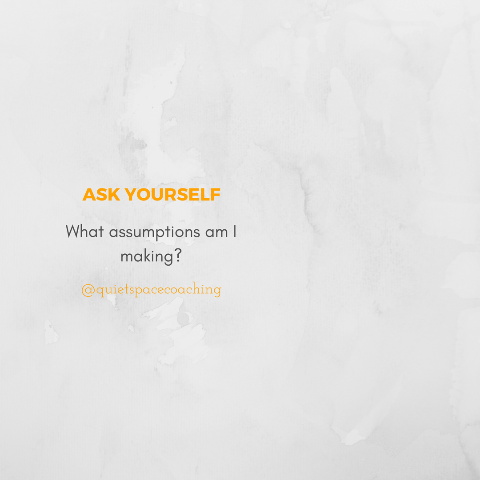
What assumptions are you making?

What assumptions am I making

This is relevant in so many areas of life. Your relationships, personal struggles and challenges, the daily grind, etc. In truth, your reality often isn’t what you think it to be. Examine those assumptions.

– Written by Natalie Snodgrass Tan, Quiet Space Ltd