Blog

Blog

Career management and planning

Coaching for introverts

IMG_0953

A bit of light-hearted relief as we head towards the end of the working week – this is for all you grumpy introverts. There appear to be rather a lot of you out there – hello!

Now, I do appreciate the irony in this, but if you’re feeling like this and if you’re fed up with your work – well, I’d love to talk to you. Coaching can be hugely helpful in managing communication, relationships, performance under pressure, and career transitions. I’ll even stick my neck out to promise you’ll feel better after talking to me.

Drop me a message, and feel free to share this flowchart!

Coaching

Hindsight is always 20:20

IMG_0945

I think we all need a reminder of this every so often. I was chatting with one of my best friends a few weeks ago about choices we’d made as teenagers and we got to musing about different life paths.

Ok, stop right there.

You see, a lot of the choices we make in life are made with the best information that we have at that point in time. Vision in hindsight is always 20:20. There is nothing – nothing – to guarantee that, had you made a different decision back then, you would be in a happier or more successful place right now. Don’t forget too that everything in our past has shaped us in ways that we can’t see.

Ruminating and speculating on ‘what-ifs’ are rarely helpful things to do. We are shaped by all that has passed, but the past is gone – learn from it by all means, but what matters is what you do with what you have in this moment. That’s yours for the taking.

– Written by Natalie Snodgrass Tan, Quiet Space Ltd

Latest posts

I’m Fine

IMG_0932

The thing about mental health is that you can never really know how someone is feeling simply by looking at them. People put on all sorts of masks every day – to feel safe, to feel normal, to stop people telling them to cheer up, it might never happen. I’m fine!

Well, sometimes you’re not. It won’t last forever, but while you’re in that space, it can be very distressing, and sometimes frightening.

Check in on your friends and family. Take time to really listen, to go past the small talk and make a genuine connection. Don’t judge or jump to conclusions. Be kind, and gentle with other people’s hearts. We need that more than ever the way this world seems to be going.

Meditation

A guided meditation to melt the winter chill

IMG_0874

The ice on the car this morning was mesmerising. That said, me and cold don’t really mix; I’m much more of a tropical person, which is why I’m currently sitting in front of a blazing fire and thinking warm thoughts.

Here’s a guided meditation to melt some of the chill. The full meditation is about 15 minutes long and so this is just a beginning snippet.

Close your eyes.

Breathe in really deeply, to the count of three, and hold it for two counts. Then breathe out to the count of three again. Repeat this for several breaths.

Start to bring your focus to the sensation of breathing. The rise and fall of your chest, the rhythm, the feel of the air you breathe out. It’s cold outside. But the breath leaving your lungs is warm. Focus now on the warmth of that breath.

And as you keep breathing deeply, I’d like you to imagine that you’re walking in a field. Take a moment now to use your senses to bring your surroundings to life. What do you see around you?

What do you hear?

What can you smell?

As you continue walking, you see in the distance that there is a gathering. It looks like a group of people sitting next to a campfire. And even though you’re not sure why, you’re drawn to meet with these people. It feels safe.

If you’d like to get the rest, drop me an email and if there’s enough interest I’ll do an audio recording of the full meditation that you can listen to in your own time.

– Written by Natalie Snodgrass Tan, Quiet Space Ltd

Articles

January and that New Year Resolution Jazz

We somehow appear to be over halfway through January. How’s your month going so far? Did you make New Year resolutions? And if you did, how far have you stuck with them?

Last week I came across a quote that said “January is the Monday of the year”. The analogy is fitting, I suppose, for that (often reluctant) return to work after an extended break – starting the engine from cold; pulling out the choke; jump starting the battery. Excuse the motoring metaphors; I’ve currently got my next car on the brain (the Suzuki Jimny, in Kinetic Yellow, but I digress).

You may have read the research that tells us why January, despite its standard 31 days, always feels like the longest month of the year. Yes, science has spoken. That, plus January’s often the longest month between paydays. So not only are you cold and grumpy, but now, to add insult to injury, you also don’t have any money.

RozChast©Roz Chast, The New Yorker

It’s interesting, therefore, that for that final January flourish, lots of us then place ourselves under pressure by setting resolutions that are unsustainable, not fully thought through, insufficiently specific, or have the wrong focus. You’re going to lose ten pounds, save more money, eat less sugar, stop drinking, and argue less with your partner. You’ll start with the best of intentions, and burn brightly for two weeks before life catches up. Indeed, some research conducted by Strava discovered that in 2018, 12 January was the day that most New Year resolutions ended up slinking guiltily into the shadows.

Where did my motivation go?

So what happened? According to Dr Raj Persaud in his book The Motivated Mind, the science of self-motivation helps us understand that there are only three reasons why people don’t achieve what they want: resource depletion, inadequate tracking, and goal conflict.

‘Resource depletion’ occurs when your resources are insufficient for the task. That might be in practical terms (for instance a genuine lack of time, or not enough funds), but more often than not it’s physical or emotional (lack of energy, low mood).

‘Inadequate tracking’ refers to when you fail to adequately monitor progress towards attaining your goal. Because steps towards goal achievement are often gradual and incremental, measuring your progress provides valuable feedback on how effectively you’re working and how close you are to your target. If you don’t know where you are, it’s difficult to see how to get to where you want to be.

Finally: ‘goal conflict’. This occurs when a goal that you set is incompatible with one or more other things that you set out to do. Maybe the last time you resolved to participate in Dry January, you lasted 10 days because you wanted to kick back and relax the weekend after returning to work. Often the conflict is between longer-term goals and shorter-term desires – psychological experiments have repeatedly shown that we have a predilection for valuable outcomes sooner rather than later.

Our inbuilt preference for earlier gratification means that we’re battling our biology every time we try to focus on that distant reward. And the thing about willpower is that generally it is quite an unreliable beast, so thinking that you’ll be strong enough to stick to your goals this time is, unfortunately, not a particularly effective strategy.

What to do?

Firstly, don’t abandon the desire for self-improvement; having New Year resolutions isn’t in itself a problem. The problem that lots of us have, even before we come to the question of motivation, is that we don’t set the right goals. Sometimes, in fact, we might not even really be ready for change.

Are you stuck in chronic contemplation?

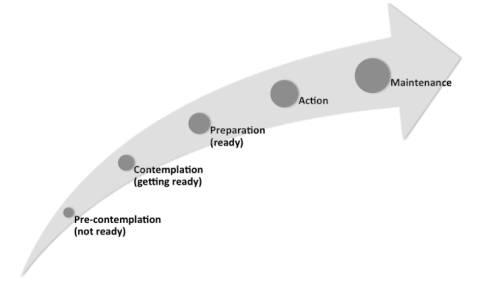
TTM(The Transtheoretical Model of Change, Prochaska and DiClemente)

Studies of change have found that people move through a series of stages when intentionally modifying their behaviour. Change, in other words, is something that unfolds over time. I think the most pertinent stage to talk about here is that of Contemplation, where people intend to change, but aren’t quite ready – they know what the advantages of change will be, but they’re also highly aware of the drawbacks. This can produce significant ambivalence and procrastination, which often means that people stay stuck.

No surprise then that most resolutions, apparently, are repeated five years in a row!

If you’re stuck in chronic contemplation or are otherwise getting in your own way, you need to tackle this first. This is where psychological coaching can be really valuable, helping you to understand and modify unhelpful beliefs, tackle underlying cognitive rules and assumptions, and learn to develop greater self-belief and self-acceptance. For now, though, I’m going to assume that you’re ready for action.

Goal set, game on

Here’s where it all starts to happen. How do you set satisfying and achievable goals? When I work with my coaching clients on this, we go through a process that includes goal clarification, prioritisation, and design. The kinds of questions we might explore at each stage look somewhat like this:

Clarification: What’s the overarching goal? Why do I want this? How does it align with my needs and values? Is this goal short-term in nature or does it require motivation to be sustained over a longer period?

Prioritisation: How high a priority am I placing on this goal? Where does it sit in my overall goal hierarchy? How does it align with my other goals? How can I address any goal conflict?

Design: Am I setting dead person’s goals? How can my overarching goal be broken down into achievable steps?

During the process, we also pause to reflect on a few important things.

First things first: What the heck are dead person’s goals?

Well, simply put, they’re goals a dead person can achieve better than you.

Language is really important when it comes to goal-setting. Goals like “I want to stop drinking”, “I want to eat less sugar” or “I want to argue less with my partner” are all about doing less of something or stopping something (let’s face it, the dead person’s got that in the bag, and he’s way ahead of you).

Instead, think about how you can turn that around to aim for positive action. What you focus on you tend to create, so focus on the things you want, not the things you want to get rid of. Ask yourself: So if I stop this, or do less of this – how are things going to change? What will I start doing, or do more of? How will I behave differently?

Vagueness is not a goal-setting virtue

Remember inadequate tracking? It’s hard to know how close you are to your destination if you don’t know where you are – but even before that, it might have been Seneca who said “if a person doesn’t know to which port they sail, no wind is favourable”.

So be clear about what you want your end result to be. Be specific about what, how, and by when, and make sure too that what you’re aiming at is realistic and achievable within the parameters you’ve set yourself. And then don’t forget to check in with yourself on a regular basis to assess your progress and recalibrate if you’ve gone off-track. 

Daily commitment to action and consistency are key

Let’s assume you’ve set a great goal. You have a vision of what you want your end point to be. Now what? How do you get from here to there?

Here’s where we come to talk about a systems mindset. To read more about this, I highly recommend you pick up Scott Adams’ book How to Lose At Everything And Still Win Big: Kind of the Story of My Life. In Adams’ words: “For our purposes, let’s say a goalis a specific objective that you either achieve or don’t sometime in the future. A system is something you do on a regular basis that increases your odds of happiness in the long run. If you do something every day, it’s a system. If you’re waiting to achieve it someday in the future, it’s a goal.”

Having a systems mindset means that, rather than being end-state and future-oriented, you become process and present-oriented. You can see the longer-term vision, but what you’re doing today is the thing that matters most. If your goal’s to run a marathon in September, and you start training now, you’re not going to see any difference tomorrow. But follow that training plan week in, week out, and come the marathon, you’ll be ready. You may not be able to tick that overarching goal off your list until September, but if you commit to consistent daily action, you’ll be winning each and every day.

So start breaking down that overarching goal into small, achievable daily ways of being that you can sustain over the longer term. Think micro-resolutions – commitment to a limited, specific and measurable change in behaviour or attitude that produces a tangible and immediate benefit. It taps into that predilection for immediate gratification and the positive feedback keeps us encouraged. And you know what else? One of the best cures for lack of motivation is taking action. Just do it.

And that’s it – I do like it when a plan comes together. One final parting thought before I go. You can do all this at any time. You don’t need to wait for a new year, a new month or even a new week to start working towards the change you want to see. So if you abandoned your 2019 New Year resolutions last week, here’s your next chance. It starts now. You’ve got this.

– Written by Natalie Snodgrass Tan, Quiet Space Ltd

Coaching

Swallow the toad

IMG_0837The famously witty French writer Nicolas Chamfort reportedly said: “All literatures might be ransacked in vain for a more repulsive saying than this, that a man must swallow a toad every morning if he wishes to be quite sure of finding nothing more disgusting still for the rest of the day.” Mark Twain, meanwhile, is (wrongly) credited with the version of the saying that talks about eating the frog.

Either way, the sentiment is the same. Got an unpleasant task to do? JFDI and get on with your day. The longer you leave it, the more horrible it will look.

And if you have two toads? Swallow the bigger, more disgusting one first.

That’s your life advice today from Quiet Space Coaching.

Values

Advent Calendar 2018

IMG_0746IMG_0747IMG_0748Over December 2018 I did a special Instagram series – an alternative Advent calendar, because often all you need to give your life more meaning is to do things for other people without expecting anything in return, and to be thankful for everything that you have been blessed with.

Themes:
1st – warmth
2nd – reconciliation
3rd – reading
4th – gentleness
5th – outdoors
6th – colour
7th – music
8th – time
9th – appreciation
10th – rest
11th – welcome
12th – light
13th – connection
14th – perspective
15th – support
16th – fellowship
17th – gratitude
18th – peace
19th – vulnerability
20th – whimsy
21st – impact
22nd – make a wish
23rd – love
24th – angels

Head on over to http://www.instagram.com/quietspacecoaching to catch up on what you missed.

– Written by Natalie Snodgrass Tan, Quiet Space Ltd

Acceptance and Commitment Therapy/Coaching

Leaves on a stream meditation

Try this meditation the next time you need some headspace.

1) Find a comfortable, quiet space where you won’t be disturbed, and sit down and close your eyes. (Don’t lie down because you might fall asleep and that isn’t the point of this exercise.)

2) Imagine you’re sitting by the side of a gently flowing stream. Picture this in your mind now, and use your senses to really make the scene vivid. What can you see? Smell? Hear?

3) Now, for the next few minutes, sit by this stream and for every thought that pops into your head – positive, negative, unformed – imagine that you’re placing that thought on a leaf and letting it float downstream.

4) If your thoughts stop, just watch the stream. When they start again, carry on with the exercise.

5) If you get distracted and forget what you’re meant to be doing, that’s ok. Just bring back your attention when you realise that it’s wandered, and start placing thoughts on leaves again.

6) Let the stream flow at its own rate; don’t try to wash away the leaves. Let them float away in their time.

7) If a leaf – or thought – gets stuck, let it hang around. Don’t force it to float away. Let it float away when it can.

8) If a difficult feeling arises, just acknowledge it. Just say “here’s a feeling of anger/impatience/frustration/etc.” Then place those words on a leaf, and let the leaf float away.

9) Again and again, your thoughts will hook you and you’ll get distracted. This is normal and natural and will keep happening. Just keep returning to the exercise when you realise this has happened.

10) When you are ready, bring the exercise to an end. Tune back into your surroundings and open your eyes. Welcome back.

– Natalie Snodgrass Tan, Quiet Space Ltd

Career development

Time to fly


It’s your time to fly. There is so much waiting for you, somewhere beyond the current boundaries of your ordinary life – something new, and wonderful. But you’re not going to get it by doing the things you’ve always done. So it’s time – time to spread your wings and get out of that comfort zone. Time to find something extraordinary.

Go out there and achieve the greatness you have in you.

– Written by Natalie Snodgrass Tan, Quiet Space Ltd

Journey

Suit of armour

suitofarmourWhen we protect ourselves so that we don’t get hurt, that protection can become like armour. It keeps out the potential damage, but it can also shield us from the things that we need to be touched by. I think in order to love we have to be willing to accept the possibility of pain. I want to live life wide open, welcoming in the kindness and the tenderness of this world alongside its sorrow. I want to let my guard down and leave the armour behind; it only imprisons the heart.

So allow people to get to know the real and authentic you, and see where it takes you. Try wearing your heart on your sleeve. Take a chance, take a leap of faith, place your trust in people. Not everyone will like you, but that’s ok. Plunge in and find someone who will love you as fiercely as you them.

– Written by Natalie Snodgrass Tan, Quiet Space Ltd