Blog

Blog

Career development

Life is short

Time’s a-ticking; life is short. NOW is the time to start your journey towards the full life that you were meant to live! If you’re on the cusp of major changes in either your personal or professional life, and need support to realise your full potential, drop me a message and let’s work together.

Video taken in June 2018 of A Million Times At Changi, @humanssince1982, Changi Airport, Singapore.

– Written by Natalie Snodgrass Tan, Quiet Space Ltd

Career management and planning

Turn left?

IMG_8464Turn left? Turn right? Whovians know what happened when Donna turned right instead of left: an alternate reality in which she never met the Doctor, directly leading to his death and eventually a descent into world dystopia.

I think a lot of us feel that way about significant decisions. Right? Left? Pros and cons. What ifs. How do I know what the right decision is? What if I make the wrong decision and live to regret this? Cold feet at the last minute. Second-guessing yourself.

I believe the truth is that we can never know the full implications of any decisions we make. We need to make decisions based on the best knowledge that we have at any given time, and then commit and follow through.

If you’re gripped by decision paralysis, remember this: much of the time there is no right or wrong decision. Whatever choice you make will have its own outcomes – the true impact of a decision is not seen in the moments after making it, but depends on you making that choice the right one for you. Don’t look back to fret about alternate realities that may never have happened even if you had made a different decision.

If you’re having problems making big life and career decisions, coaching can help. Drop me an email or message and let’s get this show on the road.

– Written by Natalie Snodgrass Tan, Quiet Space Ltd

Articles

Thoughts become things – cognitive behavioural coaching and taking…

Men are disturbed not by things, but by the view which they take of themLast week I wrote about learning more about cognitive behavioural psychology as part of my ongoing professional development – often encountered in the form of cognitive behavioural therapy (CBT), but also increasingly employed in the coaching domain. This post also links to my previous post on freedom where I wrote about making active choices.

I think the quote above, from the Stoic philosopher Epictetus, sums up the core of CBT very pithily. The origins of modern psychotherapy can legitimately be traced to classical philosophical schools like Stoicism, which is, if you will, the original cognitive therapy (Albert Ellis, who founded the first form of CBT, Rational Emotive Behaviour Therapy (REBT), has acknowledged the lineage from Stoic philosophy).

There is a great deal of synergy between the cognitive behavioural approach and coaching, particularly from a constructivist perspective. People can fall into the trap of being a passive participant in their own lives, and it’s very easy to tip over into becoming a victim of your circumstances. I often talk to clients about becoming actively involved in constructing their own realities (note: which is not the same as ignoring objective facts!) rather than playing a part in a story someone else has written for them. Learning and growing occurs when you are actively involved in a process of making meaning in your life, understanding the thoughts and beliefs that you hold and then taking conscious control of them.

The concept of mental control, heavily distilled, might look somewhat like this.


In a nutshell, there are things we can control, things we can influence, and things we can’t really do anything about. Although we might have legitimate concerns about what other people do and what’s happening in the world, very often we have little to no control over these things. What we do have control over are what we choose to think and feel, and how we choose to behave. And the kinds of thoughts and beliefs and feelings that we hold, and our subsequent behaviour, can make our realities happy or miserable. This is at the core of the cognitive behavioural approach. CBT and its coaching counterpart, CBC, teach that it is the meaning that we attach to events that causes our emotional reactions, not the events themselves, and that we can learn to choose different behaviours through retraining our thoughts and beliefs.

A key word here is ‘choice’. Everything that we do is a choice. Sometimes we may think that we have no choice but to respond or react in a certain manner – we say things like “she made me angry”, “I was forced into a corner”, “he is the reason I am in this predicament”. The trouble with this is that it opens up the door to everyone else being the cause of your problems, and us discounting or forgetting the part we have played in any given situation (often also the part that we continue to play, if we’ve fallen into the role of victim).

What’s the alternative? Accepting responsibility for our own thoughts, feelings and behaviours. Viktor E. Frankl said that “…everything can be taken from a man but one thing: the last of the human freedoms – to choose one’s attitude in any given set of circumstances, to choose one’s own way.” I very much like this quote because I think taking psychological responsibility – responsibility for our thoughts and feelings – is fundamental to our psychological wellbeing. This is a world away from a damaging  blame game – it moves us right across into the empowerment of realising that you do not have to rely on changing others, or your situation, before you can feel better or act differently.

Your thoughts don’t have to become your reality. They’re opinions, not facts. (Opinions welcome in comments below!)

– Written by Natalie Snodgrass Tan, Quiet Space Ltd

Career development

Your life, in a sentence

Be the author of your own life

I was delighted with this display from The Novel Encounter when I saw it at the National Gallery in Singapore a few weeks ago. A surprise novel in a beautifully minimalist wrapper, summarised in a single sentence. It made me think of three things.

1) Curating my mystery retreat boxes as part of my new transformational development programme for women (currently itself under development!)

2) What the summary of my own story would be. I’m still writing it, so I’ll get back to you on that one.

3) Those Penguin Books memes about the story of your life. Will yours be:

– Oh shit was that today: A memoir
– Well I was clearly into that more than you were: A love story
– Plan B
– If only: A tale of regrets
– Don’t actually press send: Advice from the grave
– How to accept anything: A story about giving up
– Well, that didn’t go as planned
– Finding that special someone: A guide to dying alone

Well? What’s yours going to be? You can pick, or if you don’t like any of those then write your own. Make it a good one, ok?

– Written by Natalie Snodgrass Tan, Quiet Space Ltd

Career management and planning

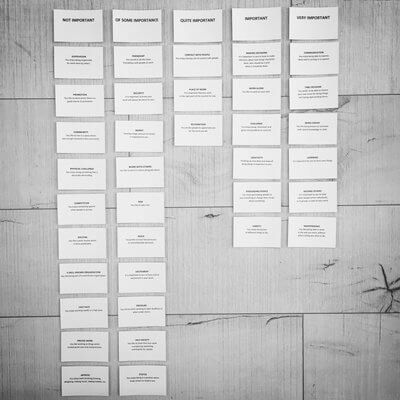
Values card sorting


rsz_img_8432At a coaching session on Monday morning we made use of this card sorting activity. It’s an enjoyable hands-on exercise that can often help bring clarity to the values that are important for you to have in your work.

It’s been years since I did this exercise myself, so I thought I’d see what had changed in the interim. It was very affirming to discover how much my work at the moment aligns with everything that is very important to me.

Life is short. Do what you love. And if your work isn’t currently bringing you satisfaction, drop me a line.

– Written by Natalie Snodgrass Tan, Quiet Space Ltd

Coaching

Lessons from a sofa

rsz_img_8426

On Monday I was once again at Draycote Water, which has become one of my favourite summer coaching venues. While I was surrounded by nature, one of my clients sent me this photo of a sofa at the spa she’s currently at. It looks a bit like a posh hay bale, and comes complete with authentic leaves down the back of the cushions. Apparently there are several of these sofas around the spa, but people weren’t really sitting on them. Because they are prickly.

It struck me that there were a couple of worthwhile lessons to take from this.

1) It is good to take time out for yourself – ensuring that you are paying regular attention to your psychological and physical wellbeing is really important. It’s not selfish unless all you ever think about is yourself.

2) There is sometimes a big difference between what you think will be good for other people and what will actually be good for them. It is useful to ask rather than assume.

3) Things that look nice are not always nice to have. Perception is not the same as reality. This third point was also one of the significant takeaways that my client took away from Monday morning’s session.

There you go, lessons from a ‘quirky’ sofa.

– Written by Natalie Snodgrass Tan, Quiet Space Ltd

CBT/CBC

Cognitive behavioural coaching

Continuing professional development is vital in order to ensure that you’re keeping your knowledge and skills up to date and fit for purpose. I’m studying coaching psychology at the moment and it’s been very interesting to discover how much my coaching practice already aligns with cognitive behavioural principles.

The essence of cognitive behavioural psychology is that you feel as you think. It is the meaning we attach to events that causes our emotional reactions, not the events themselves. I very much like this proposition because I think taking emotional responsibility is fundamental to our psychological wellbeing. I’ll be posting a longer article on this very soon – keep an eye out for it.

Looking forward to learning more so that I can work with clients even more effectively!

– Written by Natalie Snodgrass Tan, Quiet Space Ltd

Humour

A tale of sleep hygiene

IMG_8256Me: I’m so tired; I’m going to collapse into bed and sleep for a few days

Me: *gets into bed*

Me: I wonder if I should buy a Pranamat

Me: I haven’t checked my email for the last ten minutes; better rectify that

Me: How do I get A to appreciate that when I say ‘can you please do X’ I don’t mean in three years’ time (and counting)

Me: If I get those things ticked off my to-do list now then I’ll be ahead for tomorrow

Me: I’m hungry

Me: oooh new Instagram posts

Me: Sleep is for wimps, right?


Note to self: Practise better sleep hygiene
Note to readers: #doasisaynotasido

(Nope coaster by @gemmacorrell)

– Written by Natalie Snodgrass Tan, Quiet Space Ltd

Articles

Freedom

I’m not sure if today’s blog post is going to hang together coherently. There are a few themes running through my head that all connect, but I’m not quite convinced I’ve connected them yet. See what you think.

Anyway. A couple of weeks ago, while attending Mass in Singapore, I listened to a homily about freedom. The message was that freedom shouldn’t be equated with liberation.

Dictionaries commonly define freedom first and foremost as “the power or right to act, speak or think as one wants”. Liberation, meanwhile, is commonly “freedom from limits on thought or behaviour”. So, a bit of a circular reference, but the point was that freedom shouldn’t be about self-gain – what I want, when I want – but should instead be about exercising free will in the service of others, with conscience and responsibility.

Now, there was obviously a religious slant to this, but whether you are of any other faith or none, I thought there was something to reflect on and find relevance in. I last wrote about freedom in the context of wandering, in the context of a book I’ve been reading called “A Little Nostalgia for Freedom” (Steve Bonham). And when I think about wandering, I think about wandering with a purpose. Not to get somewhere, because that is somewhat paradoxical, but as part of inhabiting the world in a certain way; as part of an active choice to remain in a mode of inquiry.

Which brings me to the choices we make. I’ve argued before that everything we do is an act of choice – even when it might seem that we haven’t got a say in a matter, we remain in control of how we react and respond to our circumstances. Henley writes in Invictus: “It matters not how strait the gate/How charged with punishments the scroll/I am the master of my fate/I am the captain of my soul.” The truth is the same for the freedoms we exercise. I think that rights necessarily come with responsibilities and limits, because to argue otherwise leads to anarchy. So in freedom we have to take responsibility for the ways in which we choose to think and act.

You could look at this in two ways – responsibility to self, and responsibility to others. First, there is little point in blaming others for the decisions we make. To do so is to play victim and that’s a slippery slope that comes to no good end. Beyond this, I like to think that there will always be a moral core of decency in people that chooses to look for the best in others and tries often to act for the higher good rather than the selfish gain.

My own take-home message: In a world where you could choose to be lots of things? Choose to be kind.

– Written by Natalie Snodgrass Tan, Quiet Space Ltd

Career development

Breaking barriers (and ceilings)

I’ve got a thing for ceilings. The more architecturally interesting, the better. When I posted this on my personal Facebook timeline a few days ago, a friend left a comment that made me stop and think.

Me: I’ve got a thing for ceilings.
Her: And trying to break them! Go Nat! 💪

I’ve never thought of myself as breaking ceilings. But then it occurred to me that this is what I work on with people all the time – breaking through their barriers. And the more architecturally-significant the ceiling, perhaps all the more its being fair play. Right?

Now stop reading and go break through some ceilings.

– Written by Natalie Snodgrass Tan, Quiet Space Ltd